

You’ve probably seen it — a child waiting in line, a tablet in hand, or a toddler scrolling through videos before they can even talk.
In today’s world, silence feels uncomfortable. Waiting feels unproductive. Boredom feels… wrong.
But here’s the truth: boredom isn’t the enemy. It’s one of childhood’s most powerful teachers.
The Vanishing Art of Being Still
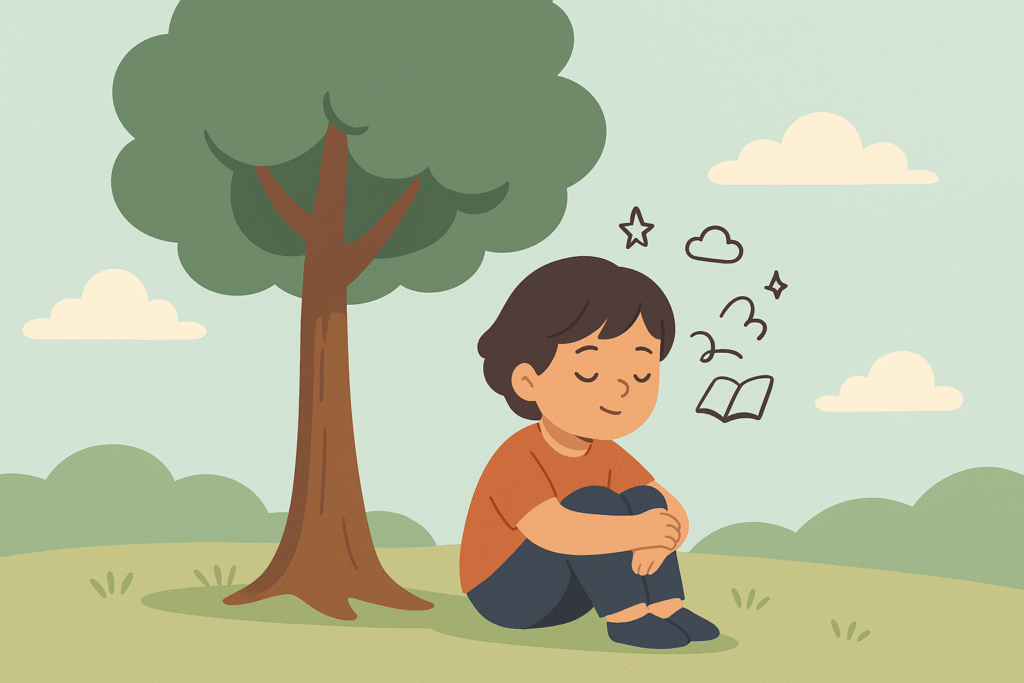
Just a generation ago, kids spent hours lying on the grass, watching clouds drift by, or making up games with nothing but sticks and imagination. Those quiet moments weren’t wasted time — they were mental breathing space.
Today, our children’s worlds are filled with constant stimulation — shows, games, notifications, reels, and endless content. The moment stillness appears, we rush to fill it.
But the cost? Their ability to sit with their own thoughts, to create, and to dream.
The Science Behind Boredom
Research shows that boredom activates the brain’s “default mode network,” the part responsible for self-reflection and imagination.
It’s where creativity takes root — where stories are born, ideas spark, and empathy grows.
When kids are constantly entertained, they don’t get to practice that quiet inner world-building. Their attention spans shorten, and their ability to self-soothe and create meaning from stillness weakens.
Simply put: boredom builds the muscles of imagination.
Why Boredom Feels So Uncomfortable (for Parents Too)
Let’s be honest — seeing your child bored can feel unsettling.
You might worry: “Shouldn’t I be doing something? Shouldn’t they be learning, playing, or achieving?”
But here’s the twist: when we rush to fill every quiet space with activity or screens, we accidentally teach kids that silence = emptiness.
Instead, we can show them that silence = possibility.
How to Reintroduce Healthy Boredom
It’s not about removing all technology — it’s about balance.
Here are some ways to gently bring back those moments of digital silence:
1. Create “No-Screen Gaps”
Build tiny screen-free windows: 15 minutes before bed, car rides, or mealtime. Let kids simply be — no distractions, no agenda.
2. Offer Tools, Not Entertainment
Keep art supplies, books, puzzles, and building blocks around. Let them create instead of consume.
3. Go Outside — Without a Plan
Nature naturally invites curiosity. Let kids wander, collect, imagine, and observe without structure.
4. Model It Yourself
Kids copy what they see. If they see you scrolling during every quiet moment, they’ll do the same. Show them that stillness is strength.
The Quiet Magic of Doing Nothing
Some of the world’s greatest ideas — from inventions to art to storytelling — were born from boredom.
When kids learn to face stillness, they learn to listen to themselves.
So next time your child says, “I’m bored,” don’t rush to fix it.
Smile and say, “That’s great — I can’t wait to see what you come up with.”
Because in that silence, imagination whispers.
And from those whispers, a child’s inner world begins to grow.
No Comments