

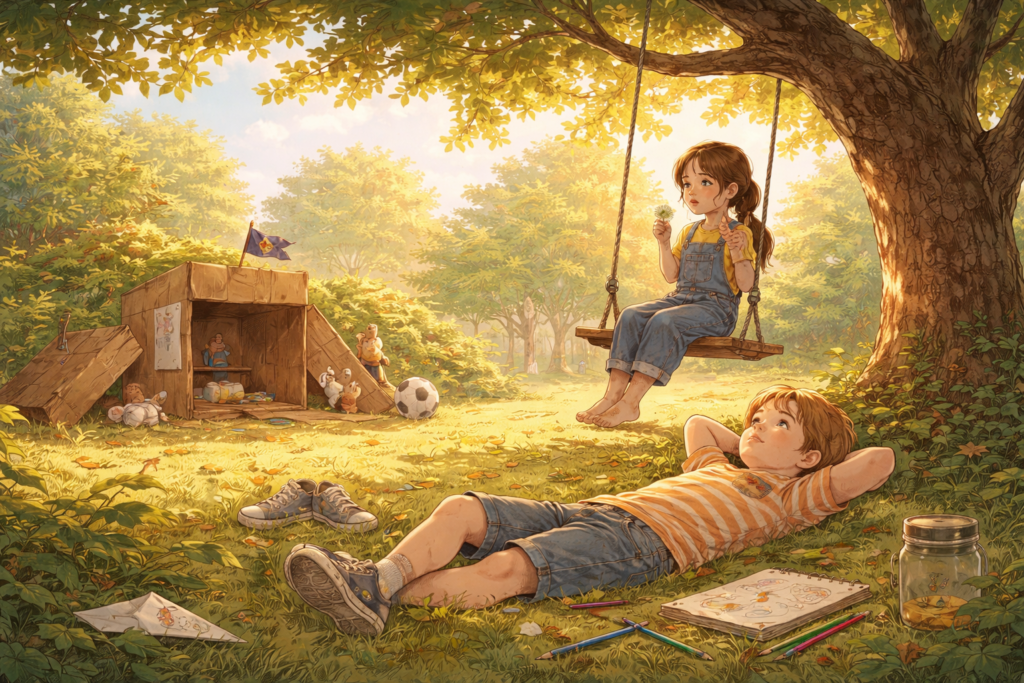
Introduction: The Death of Boredom
Ask any parent today how often their child says, “I’m bored,” and watch the panic set in. For most families, boredom has become an emergency—something to be eliminated with screens, apps, streaming, activities, learning platforms, games, or “just one more episode.”
We live in a time where children rarely experience stillness. Every second is filled with stimulation: fast dopamine, fast entertainment, fast answers.
But here’s the twist—boredom isn’t the enemy. In fact, it may be the missing ingredient in childhood.
The Modern Problem: Hyper-Stimulation as the New Normal
Children today grow up in a digital ecosystem designed to keep them engaged for as long as possible. Algorithms don’t just feed content—they learn preferences, optimize dopamine feedback loops, and ensure nothing feels slow, quiet, or empty.
This creates three side effects:
-
Shortened attention spans
-
Reduced frustration tolerance
-
Dependency on stimulation to feel okay
So boredom doesn’t just feel uncomfortable—it feels unbearable.
The Forgotten Skill: Self-Generated Play
Before smartphones, boredom created worlds.
Kids turned sticks into swords, cardboard into castles, and backyards into galaxies. That wasn’t just cute—it was neurologically important.
Self-generated play develops:
-
Imagination
-
Problem-solving
-
Storytelling
-
Emotional resilience
-
Executive function
-
Patience
-
Creativity
When every gap is filled with digital content, these skills lose space to grow.
The Psychology Behind Boredom (and Why It Matters)
Psychologists describe boredom as a trigger for internal motivation. When nothing external grabs attention, the brain begins to:
-
Wander
-
Daydream
-
Construct ideas
-
Seek novelty internally
This leads to what neuroscientists call default mode network activation—responsible for creativity, introspection, and self-discovery.
In simple terms:
Boredom forces the brain to entertain itself.
Digital Boredom vs. Analog Boredom
There’s a difference between:
📱 Digital boredom — scrolling until something hooks
and
🌱 Analog boredom — sitting with discomfort long enough to create
The first numbs.
The second builds.
When a child says, “I’m bored,” and we immediately hand them distraction, we rob them of the bridge between discomfort and invention.
The Benefits of Letting Kids Be Bored
Here are the hidden advantages of boredom we rarely talk about:
1. Creativity Reboots
Great ideas require idle time. Studies have shown that boredom increases divergent thinking—crucial for innovation.
2. Emotional Regulation Strengthens
Children learn to sit with feelings without immediate escape.
3. Better Attention Span
Kids learn to tolerate low-stimulation environments—important for school, reading, and social interactions.
4. Self-Initiated Action
Boredom nudges kids to start projects, explore interests, or make their own fun.
5. Resilience and Patience
Not every moment of life is exciting. Boredom prepares them for that reality.
But Why Does It Feel Scary to Parents?
Many parents fear boredom because it triggers:
✔ Guilt (“I should entertain them”)
✔ Anxiety (“They’ll waste time”)
✔ Comparison (“Other kids are doing activities…”)
Plus, culturally, productivity has replaced idleness as virtue. Childhood has become scheduled, optimized, enriched, and monitored. Idleness feels wrong—even though it’s deeply human.
So How Do We Reintroduce Digital Boredom?
Not by banning screens.
Not by forcing silence.
But by structuring gaps.
Ideas include:
✨ Unstructured play time
✨ Screen-off hours
✨ Outdoor wandering
✨ Object play (blocks, dolls, tools)
✨ Creative materials (art, cardboard, craft)
The goal isn’t anti-technology—it’s pro-imagination.
The Long-Term Payoff: Creating Self-Directed Humans
Children who learn to sit with boredom become adults who can:
🌿 Work without constant stimulation
🌿 Think creatively without external input
🌿 Enjoy solitude
🌿 Stay with tasks longer
🌿 Innovate from scratch
🌿 Handle discomfort without escape
In a world addicted to dopamine, that’s a superpower.
A Final Thought
Parents often worry about giving their kids “enough.”
But in a hyper-stimulating world, the gift of nothing might be the most valuable thing left.
Letting them sit.
Letting them think.
Letting them wander.
Letting them create.
Because the opposite of boredom is not entertainment—it’s imagination.
No Comments